Table of Contents
For private label brands, wet wipes formula development is not simply a matter of choosing a fragrance and adding water. The formula must suit the wipe’s intended use, target consumer, nonwoven material, packaging system, expected storage conditions, and destination market. When the product is positioned for sensitive skin, every ingredient choice and every claim deserves additional review.
This guide explains how B2B buyers can manage wet wipes formula development without relying on vague terms such as “gentle” or “natural.” It focuses on the decisions that should be documented before samples are approved and mass production begins.
Why Formula Development Needs a Clear Brief
Wet wipes formula development works best when the buyer starts with a written product brief. A manufacturer cannot evaluate suitability from descriptions such as “premium,” “mild,” or “for everyone.” The brief should state where the wipe will be used, whether it remains on the skin or is rinsed away, who will use it, and which claims are planned for the package.
A facial cleansing wipe, a baby cleansing wipe, and a household surface wipe have different performance and regulatory considerations. Wet wipes formula development must reflect those differences. Even within personal care, a formula intended for occasional travel use may require a different sensory profile from a wipe used several times each day.
Define the Product Before Selecting Ingredients
Before wet wipes formula development begins, define the product category and intended use. This step influences ingredient review, label wording, testing, and the information required from suppliers. Buyers should clarify the following points:
- Body area and frequency of use
- Adult, child, baby, or general-family positioning
- Leave-on or rinse-off use
- Fragranced or fragrance-free direction
- Target market and planned sales channels
- Desired sensory feel after use
- Claims that may appear on the label or product page
- Expected pack size, closure type, and shelf-life target
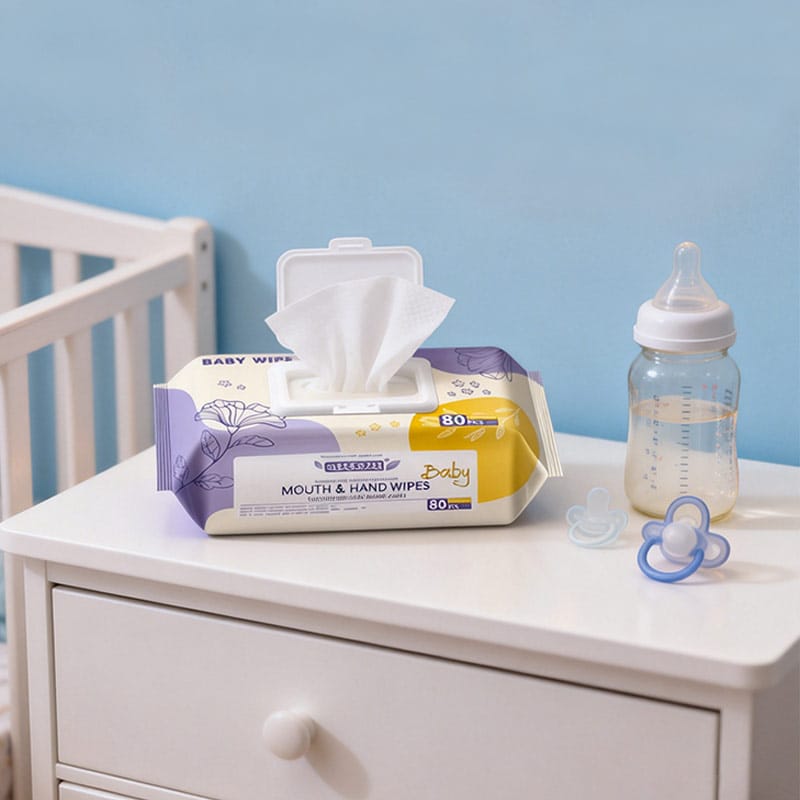
For example, buyers developing baby cleansing wipes should describe the intended cleaning task and usage frequency rather than assuming that the word “baby” defines a complete specification.
Build a Practical Formula Brief
A useful wet wipes formula development brief separates required features from preferences. Requirements may include a fragrance-free direction, restrictions requested by a retailer, or labeling conditions for a destination market. Preferences may include a lighter after-feel, a particular scent family, or a marketing ingredient that is compatible with the overall formula.
Ask the manufacturer to document the proposed ingredient list and the function of key components. Water quality, cleansing agents, humectants, skin-conditioning ingredients, pH adjusters, chelating agents, fragrance components, and the preservation approach should be considered as a complete system. Removing one component can affect stability or preservation, so “free-from” requests should be reviewed technically rather than handled as simple deletions.
Compare Common Formula Directions
There is no universal sensitive-skin formula. The best wet wipes formula development direction depends on the use case and the evidence available for the finished product. The comparison below helps buyers frame sample requests.
| Formula direction | Potential buyer objective | Points to confirm |
|---|---|---|
| Fragrance-free | Reduce unnecessary scent exposure and simplify the sensory profile | Confirm whether any ingredient supplies a masking scent and review the label wording |
| Lightly fragranced | Create a recognizable consumer experience | Review fragrance allergens, target-market labeling, and sample acceptance |
| Alcohol-free | Support gentle cleansing positioning for an appropriate use case | Define what “alcohol” means for the claim and avoid implying that alcohol-free automatically means non-irritating |
| Minimalist brief | Limit the number of nonessential marketing ingredients | Do not remove functional ingredients without checking preservation, stability, and wipe performance |
| Conditioning-focused | Target a softer after-feel | Evaluate residue, stickiness, dispensing, compatibility, and claim support |
When comparing wet wipes formula development samples, keep the nonwoven material, wipe size, liquid loading, and packaging as consistent as possible. Otherwise, a buyer may attribute a difference to the formula when it actually comes from fabric texture or moisture level.
Evaluate Preservation and Packaging Together
Preservation is a central part of wet wipes formula development because the finished product contains water and is repeatedly exposed during use. The appropriate system depends on the full formulation, pH, raw materials, production process, packaging, and intended shelf life. Buyers should avoid selecting a preservative from a marketing list without reviewing the finished system.
Packaging is also part of wet wipes formula development. Film, labels, lids, adhesives, and seals can interact with the formula or influence moisture retention. A sample approved in a temporary laboratory pouch is not necessarily equivalent to a product packed in the final printed film. Final approval should therefore include the intended packaging structure whenever practical.
Avoid Unsupported Sensitive-Skin Claims
Claims should be planned during wet wipes formula development, not added after the formula and packaging are complete. In the United States, the FDA explains that “hypoallergenic” has no federal standard or definition. A buyer should not treat the word as a substitute for ingredient review, safety assessment, or suitable finished-product testing.
Terms such as “for sensitive skin,” “dermatologically tested,” “natural,” and “gentle” also need careful substantiation and market-specific review during wet wipes formula development. Avoid disease-treatment, antimicrobial, or therapeutic wording unless the product and project are intentionally developed for the applicable regulatory pathway. Cosmetic labeling must remain truthful and not misleading.
Test Samples Before Mass Production
Sample approval for wet wipes formula development should go beyond smell and immediate skin feel. Create a written evaluation sheet so different reviewers assess the same attributes. Record sample codes and revision dates to prevent an outdated version from being approved.
- Appearance, odor, and after-feel
- Wipe wetness at the top, middle, and bottom of the pack
- pH and other agreed specifications
- One-sheet dispensing and fabric strength
- Visible package leakage or seal problems
- Formula compatibility with the final wipe and package
- Appropriate microbiological, stability, and compatibility evaluation
- Claim support required for the target market
The exact testing program for wet wipes formula development depends on the product category, formula, claims, destination market, and responsible party. Buyers should agree in writing which tests are required, who performs them, which methods apply, and what acceptance criteria will be used.
Check Labels for the Target Market
Wet wipes formula development and artwork development should remain connected. If the formula changes, the ingredient declaration, warnings, directions, claims, and supporting product file may also need revision. Lock the formula version before approving a large printed-packaging order.
For EU cosmetic projects, buyers can use the European Commission’s CosIng database as an information resource, while recognizing that the database itself is not legally binding. The applicable Cosmetics Regulation and its annexes determine ingredient conditions, and a finished cosmetic product requires an appropriate safety assessment.
Destination-market requirements can change, and the product’s regulatory classification depends on intended use and claims. Wet wipes formula development should therefore include a market-specific review. Obtain qualified regulatory advice for the actual market rather than copying wording from another brand’s package.
Use a Buyer Approval Checklist
Before closing wet wipes formula development, confirm that the approved sample and purchasing specification match. A practical approval record should include the formula code, ingredient list, target pH or agreed range, fragrance direction, liquid loading, nonwoven material, sheet size, folding method, pack count, packaging version, intended market, planned claims, tests, and acceptance criteria.
Also define change control before wet wipes formula development is signed off. The manufacturer should not substitute a material, fragrance, preservative component, packaging layer, or key process parameter without the agreed review process. This protects consistency across repeat orders and gives both parties a clear reference when investigating a complaint.
Frequently Asked Questions
What information should I provide for wet wipes formula development?
Provide the intended use, user group, body area, frequency, target market, claims, fragrance direction, packaging format, wipe material, expected order volume, and any retailer restrictions. A specific brief reduces unnecessary sample rounds.
Does fragrance-free always mean suitable for sensitive skin?
No. Fragrance-free can be a useful design direction, but suitability depends on the full formulation, exposure, user, manufacturing controls, packaging, and supporting evaluation. It should not be treated as a safety guarantee.
Can a buyer request an alcohol-free formula?
Yes, but the requested claim should be clearly defined and checked for the target market. Buyers can also review Beierjie’s alcohol-free wet wipes product options when preparing the brief.
How many samples are normally needed?
There is no fixed number. The process depends on how clearly the brief is defined and whether the material, formula, liquid loading, and final packaging need separate adjustments. Each round should have a defined objective and recorded feedback.
When is wet wipes formula development complete?
It is complete only when the buyer has approved a documented formula version, finished-product specification, relevant testing plan, final packaging compatibility, compliant artwork information, and change-control process for production.
Discuss Your Private Label Wipes Project
Effective wet wipes formula development turns a marketing idea into a specification that can be sampled, evaluated, produced, and reordered. Beierjie supports OEM and private label projects with customizable wipe materials, formulas, sizes, packaging, and branding options.
Contact Beierjie with your product category, target market, intended use, packaging preference, expected volume, and claim direction. The team can discuss practical options for your next personal care wipes project.
PREVIOUS POST
Wet Wipes Quality Control: What B2B Buyers Should Check Before Mass Production
NEXT POST
2-Ply vs 3-Ply Facial Tissue: A Practical Buyer’s Guide