Choosing the right OEM baby wipes manufacturer is an important step for businesses that want to build a reliable baby care product line. Baby wipes are a high-repeat-purchase category, and many retailers, distributors, importers, and private label brands are looking for factory-direct solutions that support customization, stable quality, and long-term supply.
For B2B buyers, sourcing baby wipes is not only about finding a low price. It is also about product safety, material softness, formula stability, packaging quality, MOQ flexibility, and supplier reliability. A professional OEM baby wipes manufacturer can help brands develop products that match their market positioning while maintaining consistent production standards.
Table of Contents
What Is an OEM Baby Wipes Manufacturer
An OEM baby wipes manufacturer produces baby wipes according to a buyer’s specific requirements. Instead of selling standard finished products only, the manufacturer supports customized materials, formulas, packaging, sheet size, fragrance options, and private label branding.
This is especially useful for businesses that want to create their own baby wipes brand. With OEM production, buyers can develop products for different market levels, such as economy baby wipes, sensitive skin baby wipes, biodegradable baby wipes, or premium private label baby wipes.
Why B2B Buyers Choose OEM Baby Wipes
OEM baby wipes are popular among distributors and private label brands because they provide more control over product design and market positioning.
Better Brand Control
With OEM baby wipes, businesses can customize packaging design, product name, logo, and selling points. This helps create a stronger brand identity instead of selling generic products.
Product Differentiation
Baby wipes can be customized by material, thickness, formula, moisture level, fragrance, and packaging. These details help brands stand out in competitive retail and wholesale markets.
Long-Term Supply Stability
A reliable OEM baby wipes manufacturer can support repeat orders and stable production, which is important for distributors and growing brands.
Better Fit for Local Markets
Different markets have different preferences. Some buyers prefer fragrance-free wipes, while others focus on biodegradable materials, soft texture, or premium packaging.
Common OEM Baby Wipes Customization Options
| Custom Area | Available Options | B2B Value |
|---|---|---|
| Material | Spunlace nonwoven, viscose, cotton blend, bamboo fiber | Affects softness and positioning |
| Formula | Alcohol-free, fragrance-free, moisturizing, sensitive skin formula | Supports different market needs |
| Sheet Size | Small, standard, large custom sizes | Matches usage scenarios |
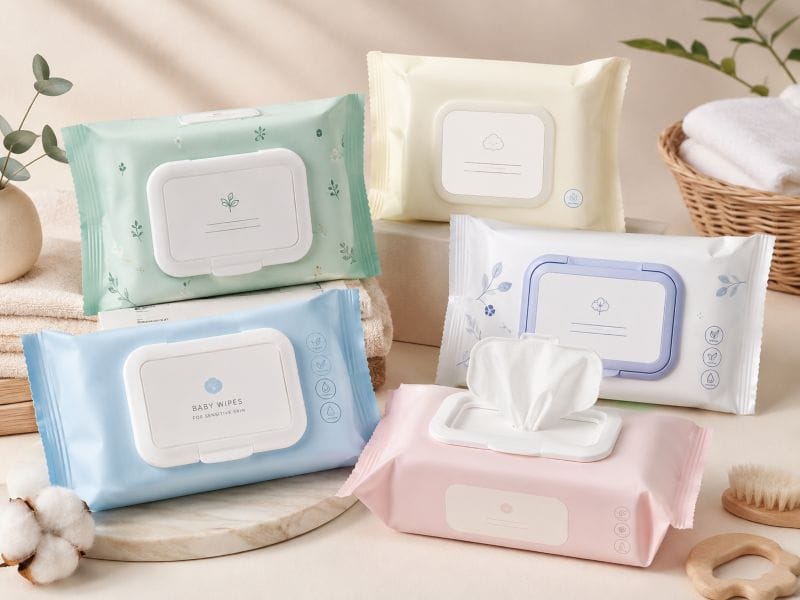
| Packaging | Flow pack, soft pack, travel pack, bulk pack | Influences retail and wholesale sales |
| Branding | Logo, label, color design, multilingual packaging | Builds private label identity |
| Count Per Pack | 10, 40, 80, 100 sheets or customized | Fits different sales channels |
This table shows why OEM baby wipes manufacturing is more suitable for B2B buyers than simply purchasing ready-made products.
Key Product Types for OEM Baby Wipes
Sensitive Skin Baby Wipes
Sensitive skin baby wipes are usually alcohol-free, fragrance-free, and designed with mild formulas. They are suitable for premium baby care brands and markets where parents pay close attention to ingredient safety.
Biodegradable Baby Wipes
Biodegradable baby wipes are made with plant-based or degradable materials. They are suitable for buyers targeting eco-conscious markets and premium retail channels.
Fragrance-Free Baby Wipes
Fragrance-free baby wipes are widely accepted in international markets because they reduce the risk of irritation and appeal to parents looking for gentle baby care products.
Travel Baby Wipes
Travel-size baby wipes are suitable for convenience stores, e-commerce bundles, promotional packs, hotels, and baby care gift sets.
How to Choose an OEM Baby Wipes Manufacturer
Check Manufacturing Experience
A manufacturer with baby wipes production experience understands softness requirements, formula stability, packaging sealing, and quality consistency.
Evaluate OEM Capability
A strong OEM baby wipes manufacturer should support material selection, formula adjustment, packaging customization, and private label design.
Review Quality Control
Quality control should include raw material inspection, production monitoring, moisture testing, packaging sealing checks, and final product inspection.
Confirm Production Capacity
For distributors and importers, stable production capacity is essential. The manufacturer should be able to support both trial orders and long-term repeat orders.
Ask About Export Support
For international buyers, export experience matters. A supplier familiar with documentation, packaging requirements, and shipping processes can reduce sourcing risk.
OEM Baby Wipes Manufacturer vs General Supplier
| Factor | OEM Baby Wipes Manufacturer | General Supplier |
|---|---|---|
| Customization | Strong | Limited |
| Product Control | High | Medium |
| Pricing | Factory-direct advantage | May include middleman cost |
| MOQ | Usually higher | Often more flexible |
| Best For | Private label brands, distributors | Small buyers, ready-stock needs |
| Long-Term Cooperation | Better | Depends on sourcing stability |
For businesses that want to build a baby wipes brand, working directly with an OEM baby wipes manufacturer is usually more suitable than buying from a general supplier.
Important Details B2B Buyers Should Confirm
Before placing an order, buyers should confirm product specifications clearly.
Material and Texture
Baby wipes must feel soft and gentle. Material choice directly affects user experience and repeat purchase.
Moisture Level
Too much liquid may cause leakage, while too little moisture reduces cleaning performance. The right moisture level should be confirmed during sample testing.
Formula Safety
Baby wipes should use mild formulas. Many buyers prefer alcohol-free and fragrance-free options for baby care products.
Packaging Sealing
Good packaging prevents moisture loss and leakage. This is especially important for export orders and long-distance shipping.
Carton and Shipping Details
Carton size, loading quantity, pallet requirements, and shipping method should be confirmed before production.
Common Mistakes When Sourcing OEM Baby Wipes
Only Comparing Price
Low price does not always mean better value. Poor material, weak packaging, or unstable formula can lead to customer complaints.
Ignoring Sample Testing
Samples help buyers check softness, moisture, fragrance, packaging, and overall quality before bulk production.
Not Defining Product Positioning
Buyers should know whether the product is for economy retail, premium baby care, eco-friendly positioning, or wholesale distribution.
Choosing Suppliers Without OEM Experience
A supplier without OEM experience may struggle with packaging design, formula adjustment, and private label requirements.
FAQ
What does an OEM baby wipes manufacturer do?
An OEM baby wipes manufacturer produces customized baby wipes for private label brands, distributors, and importers.
Can baby wipes be customized?
Yes. Materials, formulas, sheet size, packaging, branding, and count per pack can be customized.
What is the difference between OEM baby wipes and private label baby wipes?
OEM baby wipes usually involve deeper customization, while private label baby wipes may use existing formulas with customized branding.
What types of baby wipes can be produced?
Common types include sensitive skin baby wipes, fragrance-free baby wipes, biodegradable baby wipes, and travel baby wipes.
How should I choose a reliable baby wipes manufacturer?
Check OEM experience, production capacity, quality control, export ability, and communication efficiency.
Conclusion
Working with a reliable OEM baby wipes manufacturer helps B2B buyers develop customized baby care products with stronger brand control and better long-term supply stability. For private label brands, distributors, retailers, and importers, OEM production offers flexibility in materials, formulas, packaging, and branding.
By focusing on product safety, softness, packaging quality, and supplier reliability, businesses can build competitive baby wipes products for different sales channels and market segments.