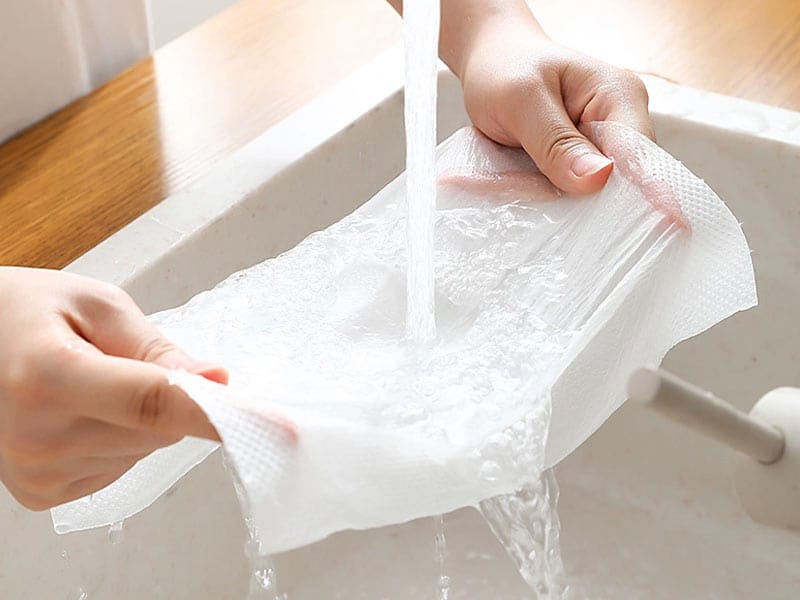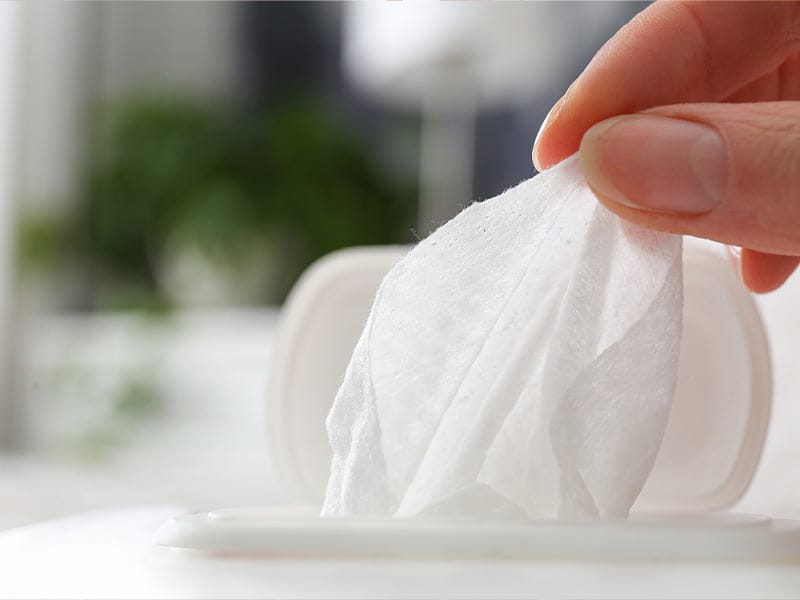
Wet wipes packaging requirements should be confirmed before mass production, not after the wipes themselves have been approved. For importers, distributors, retailers, and private label brands, the package is part of the product: it helps retain moisture, supports dispensing, carries required product information, protects the wipes during distribution, and affects how customers experience the product after opening.
A suitable wet wipes package therefore needs more than attractive artwork. Buyers should confirm the packaging format, pack count, film or container specification, opening system, resealable closure, dimensions, artwork version, carton configuration, and requirements for the destination market.
The correct specification also depends on what is being packed. Baby cleansing wipes, personal care wipes, kitchen cleaning wipes, and surface disinfecting wipes can have different formulation, labeling, and use requirements.
For a private label order, the practical rule is simple: approve the wipe and its packaging as one finished product system before mass production begins.
Table of Contents
Why Wet Wipes Packaging Requirements Matter
Wet wipes contain a liquid formulation that needs to remain within the package throughout production, warehousing, shipping, retail storage, and customer use.
Packaging failure can therefore affect a perfectly acceptable wipe.
A poor seal can contribute to leakage. An unsuitable closure can make repeated use inconvenient. Incorrect pack dimensions can interfere with dispensing. Artwork errors can create labeling problems even when the product inside the package is correct.
Packaging should consequently be included in the purchasing specification rather than treated only as a graphic-design task.
Packaging Affects More Than Appearance
A private label buyer should evaluate packaging from four perspectives:
product protection, customer use, logistics, and market information.
If any one of these areas is overlooked, a package that looks attractive in a design file may still perform poorly in commercial distribution.
Which Wet Wipes Packaging Format Should You Choose?
The appropriate format depends on product type, pack count, intended use, customer expectations, and distribution channel.
Soft Packs
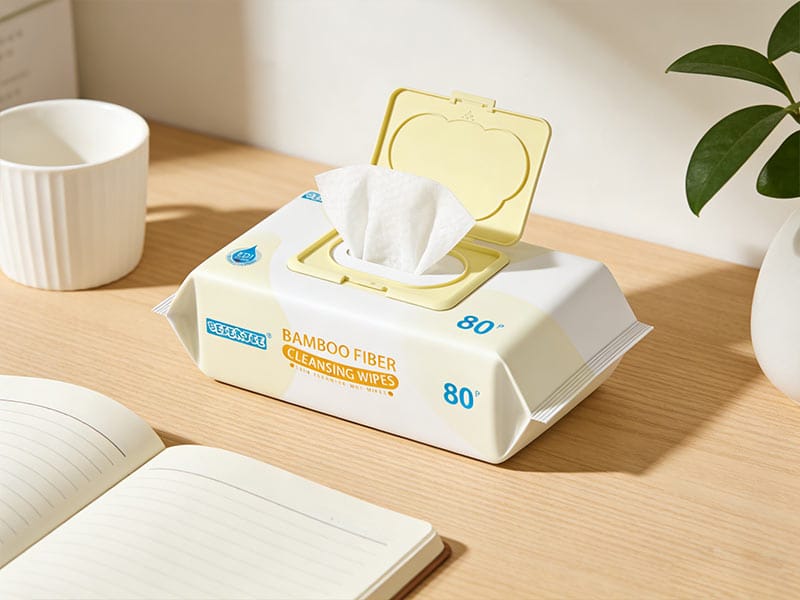
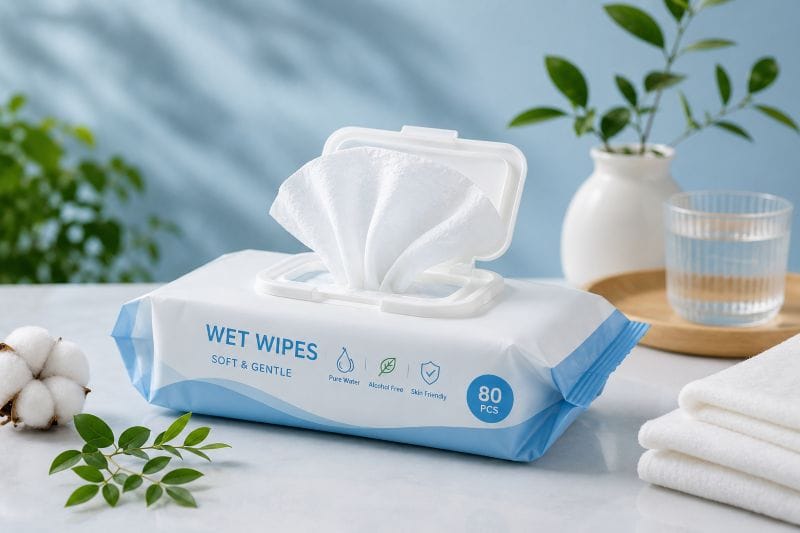
Flexible soft packs are commonly used for baby cleansing, personal care, and household wipes.
They can support different pack counts and are relatively compact for transportation and retail storage.
A soft pack may use a resealable label, a flip-top lid, or another closure system depending on the product design.
Travel and Small Packs
Small packs are useful when portability and limited-use convenience are important.
For private label buyers, smaller packs can also serve different channels from full-size family packs, but the reduced package dimensions affect artwork space and the amount of information that can be presented clearly.
Canisters and Rigid Containers
Rigid packaging can be relevant for certain cleaning and surface-wipe applications.
The container, lid, dispensing opening, wipe fold, and sheet dimensions need to work together. A canister should therefore be tested with the actual wipe rather than selected independently from the product.
Individual or Specialty Packs
Some applications may require another packaging format.
If the packaging is not already part of the manufacturer’s standard production system, buyers should confirm manufacturing feasibility, sealing method, material compatibility, and order requirements before committing to artwork.
How Should Pack Count Be Selected?
The number of wipes per package affects customer positioning, package dimensions, product weight, dispensing behavior, carton configuration, and inventory planning.
A higher count is not automatically better.
A large pack may suit household or family use, while a smaller pack can be more appropriate for travel, sampling, hospitality, or other applications.
Consider the Entire Product Range
Private label brands should avoid selecting pack counts independently for every SKU.
If several wet wipe products will be launched together, consider how the range will appear on a shelf or online store.
A coherent pack architecture can make the range easier for customers to understand.
Verify the Actual Count
Pack count should form part of sample and production inspection.
If the packaging states a specific number of sheets, the production specification needs to correspond with that declaration.
What Should Buyers Confirm About Packaging Dimensions?
Packaging dimensions should be confirmed using the finished product rather than artwork alone.
The wipe dimensions, fold, number of sheets, liquid loading, closure, and packaging structure all influence the final package.
Pack Dimensions Affect Cartons
Even small changes in an individual pack can influence how products fit inside the master carton.
That can affect carton dimensions, units per carton, palletization, warehousing, and transportation.
Avoid Finalizing Logistics Too Early
Do not calculate a complete shipping plan from preliminary packaging dimensions if the final pack has not yet been approved.
Obtain the confirmed finished-product packing information before final logistics planning.
How Does the Wipe Fold Affect Packaging?
Fold configuration is easy to overlook because customers rarely see it described on the front of the package.
Operationally, however, the fold can influence how wipes fit inside the pack and how they dispense.
Dispensing Should Be Tested With the Final Configuration
If the product is designed to present the next sheet after one wipe is removed, test that behavior using the intended material, dimensions, fold, pack count, and opening.
Changing one of those elements can affect the dispensing experience.
Do Not Approve Fold and Packaging Separately
A fold that works in one pack format may not perform identically in another.
The complete package should therefore be tested as a system.
What Makes a Good Resealable Wet Wipes Package?
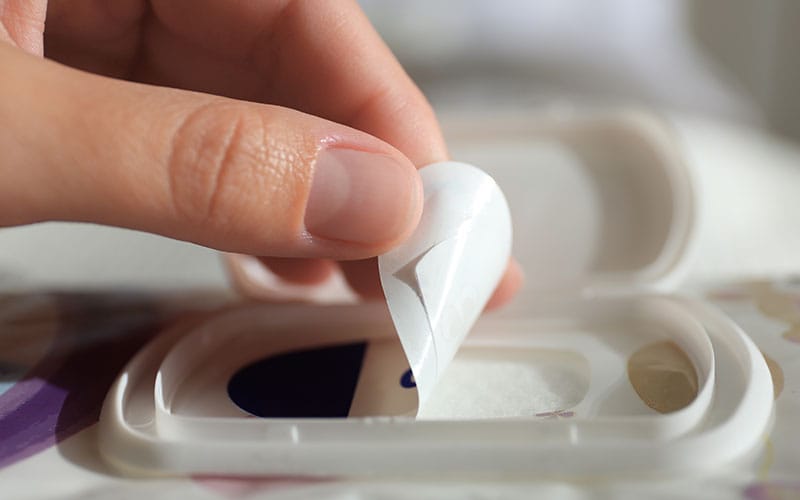
For a multi-use pack, the closure needs to remain functional after repeated opening.
FDA consumer guidance for disposable wipes advises keeping containers tightly closed to help prevent wipes from drying out. For purchasing teams, that makes closure performance an important practical check.
Resealable Labels
A resealable label should be evaluated for opening, alignment, adhesion, and repeated closure.
The buyer should test it after multiple opening cycles rather than approving it after one use.
Flip-Top Lids
A flip-top closure can provide a more structured opening system.
When a lid is used, check how it aligns with the underlying opening and whether it closes correctly.
The lid should not be evaluated only for appearance.
Opening Size
The dispensing opening should work with the wipe dimensions and fold.
If the opening is too restrictive, customers may pull several wipes at once or struggle to remove them. If the package and dispensing system are poorly matched, the user experience can suffer even when the wipe itself is satisfactory.
How Can Buyers Reduce the Risk of Wet Wipes Drying Out?
Moisture retention depends on the complete packaging system.
The formulation, liquid loading, package material, seals, closure, storage, and repeated opening behavior can all influence the product.
For purchasing purposes, the goal is not to assume that one packaging feature guarantees moisture retention.
Instead, evaluate the finished package under the conditions relevant to the product.
Inspect the Seals
Check samples for visible seal defects and leakage.
Test Repeated Opening
For multi-use packs, open and close the product repeatedly to assess closure behavior.
Confirm Storage Requirements
If the manufacturer specifies storage conditions, make sure these are compatible with the expected distribution and warehousing environment.
Review Shelf-Life Evidence
Do not assign a shelf life based on similar products.
The declared shelf life should be supported by appropriate product information and testing for the actual formulation and packaging combination.
What Causes Wet Wipes Packages to Leak?
Leakage can have several potential causes, so buyers should avoid assuming every leak comes from the same packaging defect.
Possible areas to investigate include seal integrity, packaging damage, closure design, fill conditions, pack handling, and the relationship between liquid loading and package construction.
Check Whether the Problem Is Isolated or Systematic
One damaged sample does not necessarily prove a production-wide issue.
At the same time, repeated leakage across several samples should not be dismissed as transportation damage without investigation.
Document where leakage occurs and ask the manufacturer to identify the cause before mass production.
What Should Be Checked Before Printing Private Label Packaging?
Custom artwork is one of the areas where preventable errors can become expensive.
Once a large quantity of packaging has been printed, changing incorrect information may require substantial rework.
Artwork approval should therefore occur only after the product definition is sufficiently stable.
Confirm the Product Name
The name should accurately describe the intended product.
Avoid using claims that are inconsistent with the formulation, intended use, or applicable regulatory status.
Check Ingredient Information
Where ingredient disclosure applies, make sure the information corresponds with the approved formula.
A formula revision can require another artwork review.
Verify Directions and Warnings
Directions should reflect how the product is actually intended to be used.
Warnings and other required information depend on the product and target market.
Confirm Pack Count and Product Details
Check sheet count, dimensions where declared, barcode, company information, artwork version, and other commercial information.
Lock the Correct Artwork Version
Use clear file names or revision numbers.
“Final artwork” becomes surprisingly ambiguous when several files with similar names are exchanged during development.
Why Product Claims Need to Be Decided Before Packaging Approval
Claims can affect regulatory requirements.
This is especially important for products that move beyond general cleaning or cleansing claims.
In the United States, for example, surface products making disinfecting claims fall under EPA requirements. EPA states that antimicrobial pesticide products must be registered and that efficacy claims need to correspond with the approved labeling and supporting data.
A private label buyer should therefore not add a disinfecting statement simply because a wipe contains a particular ingredient.
The claim, intended use, formula, evidence, and regulatory pathway need to align.
Skin Wipes Have Different Considerations
FDA explains that wipes used for cleansing or moisturizing skin may be regulated as cosmetics, depending on their intended use and claims.
This illustrates why the packaging for a baby cleansing wipe should not simply copy wording from a household disinfecting wipe.
What Packaging Information Should Be Checked for Baby Wipes?
Baby cleansing wipes require particular attention to formula-related statements and directions because they are intended for skin contact.
If a pack is described as fragrance-free, sensitive-skin oriented, or carries another ingredient-related statement, verify that the approved formula supports the wording.
FDA distinguishes between “unscented” and “fragrance-free” cosmetics: masking fragrances can be present in a product marketed as unscented, whereas a fragrance-free claim should correspond with the absence of added fragrance ingredients.
This is exactly the type of detail that should be resolved before private label artwork is printed.
What Packaging Information Matters for Disinfecting Wipes?
For disinfecting wipes, the package may carry information that directly affects correct use.
For U.S. surface disinfectants, EPA-approved labeling can include directions such as contact time—the period for which a surface needs to remain visibly wet to achieve the registered effect.
This information cannot be replaced with generic marketing language.
If developing disinfecting wipes for a particular market, establish the applicable regulatory and labeling requirements before final artwork approval.
How Should Packaging Be Evaluated During Sample Approval?
A packaging sample should be used, not merely observed.
Open it.
Remove wipes.
Close it.
Store it.
Open it again.
Check the package after repeated handling.
| Packaging Check | What to Verify | Why It Matters |
|---|---|---|
| Seal | Visible integrity and leakage | Protects the finished product |
| Closure | Repeated opening and closing | Supports multi-use packs |
| Dispensing | One-sheet removal where intended | Influences user experience |
| Pack dimensions | Actual finished size | Affects logistics and presentation |
| Printing | Correct artwork and legibility | Prevents labeling errors |
| Barcode | Correct placement and readability | Important for retail systems |
| Pack count | Matches declared quantity | Required for product consistency |
| Formula reference | Matches approved product | Reduces labeling mismatch |
| Carton fit | Pack arrangement and protection | Important for transportation |
Do not approve the packaging merely because the colors and logo look correct.
How Should Master Cartons Be Specified?
The master carton affects transportation, warehouse handling, and shipment inspection.
Buyers should confirm units per carton, carton dimensions, gross and net weight where required, markings, internal arrangement, and any necessary protective measures.
Check the Finished Pack First
Carton planning should follow the approved individual pack configuration.
If individual packaging dimensions change, the master carton may also need to change.
Consider Distribution Conditions
An order moving through international freight, warehouses, distribution centers, and parcel networks may experience repeated handling.
The carton specification should reflect the actual distribution route rather than only the factory packing stage.
What Should Importers Check Before a Packaging Trial?
Before approving a packaging trial, buyers should have enough information to evaluate the complete product.
Useful checks include the final wipe dimensions, material, fold, pack count, formula, liquid specification, closure, artwork, pack dimensions, and intended carton configuration.
If any of these are still temporary, identify them clearly.
A development sample with temporary artwork should not accidentally become the approved packaging reference.
How Should Packaging Changes Be Controlled After Approval?
Once the finished package is approved, changes should be managed systematically.
A change to film, lid, resealable label, dimensions, printing, fold, or formula can potentially affect another part of the finished product.
Use Revision Control
Record the approved packaging specification and artwork version.
For repeat orders, verify whether that version remains current.
Review Material Substitutions
If a packaging component becomes unavailable, ask what replacement is proposed and whether it changes appearance, sealing, dispensing, or other relevant performance.
Re-Test When the Change Matters
If a packaging change could affect product protection or customer use, review the revised package before releasing the order.
What Should a Wet Wipes Packaging RFQ Include?
A packaging RFQ should provide enough context for the manufacturer to evaluate the complete project.
Include the wipe category, intended use, target market, sheet dimensions, pack count, preferred packaging format, closure preference, branding requirements, expected order quantity, and any relevant labeling or logistics requirements.
If you already have artwork, identify whether it is draft or final.
If you do not yet know the best packaging structure, explain the sales channel and intended use so the manufacturer can suggest suitable available options.
For Beierjie private label projects, packaging should be discussed together with the material, formula, size, and branding requirements rather than treated as a separate design project.
What Should Be Approved Before Mass Production?
Before packaging materials enter mass production, the buyer should be able to identify the exact approved version of the finished product.
That normally means the wipe specification, formula, pack count, packaging structure, closure, artwork, individual pack configuration, and carton requirements have been reviewed.
Any required regulatory or test documentation should also be identified before packaging claims are finalized.
This creates a much clearer transition from sample development to production.
When Should You Contact the Manufacturer About Custom Packaging?
Packaging should be discussed early in product development, particularly when the project requires custom printing, a specific closure, non-standard pack dimensions, or several SKUs.
Waiting until the wipe formula and material are completely finalized before discussing packaging can create unnecessary redesign work.
At the same time, final artwork should not be locked before product specifications and claims are sufficiently stable.
The most efficient approach is therefore to develop the product and package in parallel, then approve the complete finished configuration before mass production.
If you are preparing a private label wet wipes project with Beierjie, provide the product category, target market, sheet size, pack count, formula requirements, preferred package type, branding files, and expected order structure so the available packaging options can be evaluated against the actual product.
Conclusion
Wet wipes packaging requirements involve much more than selecting a bag, lid, or printed design. The package needs to work with the wipe dimensions, fold, liquid loading, formula, pack count, dispensing system, sales channel, logistics plan, and destination-market requirements.
For private label orders, buyers should test the complete finished pack before mass production. Pay particular attention to seals, repeated closure, dispensing, moisture retention, artwork accuracy, product claims, carton configuration, and revision control.
The most reliable approach is to treat packaging as part of the wet wipe specification from the beginning of product development. When the wipe and package are developed and approved together, it becomes easier to control mass production and reduce avoidable problems during distribution.
FAQ
What packaging is commonly used for wet wipes?
Soft packs are common for baby, personal care, and household wipes, while rigid containers may suit some cleaning and surface-wipe applications. The appropriate format depends on pack count, intended use, dispensing, and distribution requirements.
Should wet wipes packaging be tested before mass production?
Yes. The finished packaging should be checked for sealing, closure, dispensing, pack dimensions, printing, and compatibility with the actual wipe configuration before production approval.
Can custom packaging affect the minimum order quantity?
It can. Custom printed films, lids, labels, or other packaging components may have their own manufacturing requirements. The applicable quantity should be confirmed for the specific packaging project.
When should private label artwork be finalized?
Final artwork should be approved after the product specification, formula, claims, pack count, and required market information are sufficiently stable, but before mass printing begins.
What information should I send for custom wet wipes packaging?
Provide the product type, target market, wipe dimensions, pack count, formula requirements, preferred package format, closure, branding requirements, expected quantity, and any specific retail or logistics needs.