Table of Contents
Launching a private label wet wipes brand is one of the most accessible entry points into the consumer goods market. The global wet wipes industry is growing steadily, demand is recurring, and with the right OEM manufacturing partner, you can bring a professional product to market without owning a single factory.
But the process involves more than finding a factory and slapping your logo on a package. From formulation and regulatory compliance to packaging design and quality control, each step requires careful decisions that affect your product quality, cost structure, and brand reputation.
This guide walks you through the complete private label wet wipes OEM process — step by step — based on 17 years of manufacturing experience at Huairen City Senda Medical Equipment Co., Ltd., where we have helped brands across 40+ countries launch and scale their own wet wipes product lines.
Who Should Read This
• Entrepreneurs launching a new wet wipes brand
• Retailers developing store-brand hygiene products
• Existing brands expanding into wet wipes categories
• Procurement teams evaluating private label opportunities
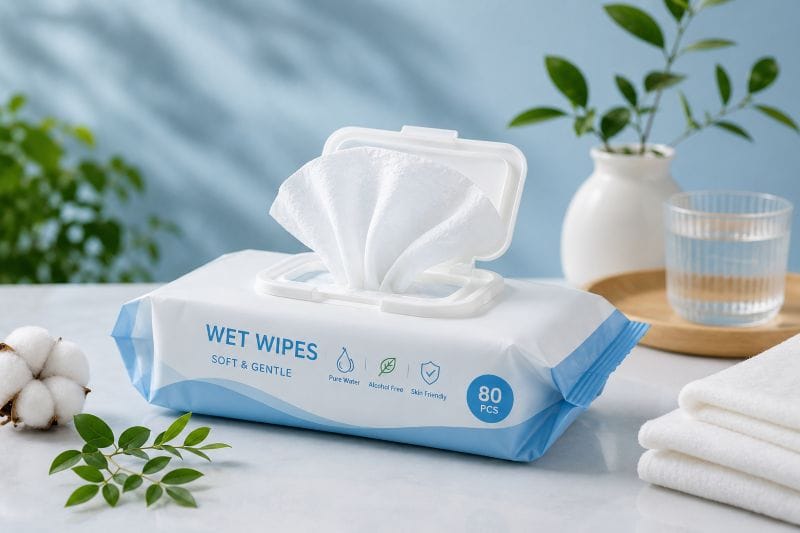
The Private Label Wet Wipes Process: An Overview
Before diving into the details, here is the full process at a glance:
| Phase | Key Activities | Typical Duration |
|---|---|---|
| 1. Product Definition | Category selection, target market, positioning | 1-2 weeks |
| 2. Manufacturer Selection | Research, evaluation, factory audit | 2-4 weeks |
| 3. Formulation & Sampling | Custom formula, substrate selection, sample rounds | 2-4 weeks |
| 4. Packaging & Compliance | Design, regulatory labeling, material sourcing | 2-3 weeks |
| 5. Testing & Approval | Lab testing, stability tests, final sample approval | 1-3 weeks |
| 6. Mass Production | Production, in-line QC, batch documentation | 2-4 weeks |
| 7. Shipping & Delivery | Logistics arrangement, customs, delivery | 2-6 weeks |
Total timeline from concept to delivery: typically 10-20 weeks, depending on product complexity and customization level.
Step 1: Define Your Product and Target Market
Before contacting any manufacturer, you need clarity on three fundamentals:
What type of wet wipes are you creating?
The wet wipes category is vast. Each type has different formulation requirements, regulatory standards, and target consumers:
- Baby wipes — Gentle, hypoallergenic formulations; strict safety standards
- Disinfecting wipes — Alcohol or quaternary ammonium-based; EPA or biocide regulations apply
- Facial cleansing wipes — Cosmetic-grade; specific ingredient restrictions in some markets
- Feminine hygiene wipes — pH-balanced, gynecologist-tested formulations
- Flushable wipes — Must meet dispersibility standards (e.g., EDANA/INDA guidelines)
- Household cleaning wipes — Industrial-strength formulations; different packaging requirements
- Adult care wipes — Designed for sensitive skin; often larger size and thicker substrate
Who is your target market?
Your target market determines regulatory compliance requirements:
- European Union — EU Cosmetics Regulation (EC) No 1223/2009, CE marking for medical wipes, CLP classification for disinfecting products
- United States — FDA registration for drug/cosmetic claims, EPA registration for antimicrobial products
- Middle East (GCC) — GSO standards, Arabic labeling requirements
- Southeast Asia — Country-specific cosmetic notifications, ASEAN directive compliance
What is your positioning and price point?
Are you targeting premium retail, value supermarket, institutional/B2B, or online DTC channels? Your positioning affects substrate quality, formulation ingredients, packaging materials, and ultimately your manufacturing cost.
Pro Tip
Before contacting manufacturers, prepare a brief product brief: product type, target market, approximate volume, desired packaging format, and price range. This allows OEM partners to give you accurate quotes and timeline estimates from the start.
Step 2: Choose the Right OEM Manufacturer
This is the most critical decision in the entire process. Your OEM manufacturer determines your product quality, compliance status, scalability, and long-term competitiveness.
Key evaluation criteria include:
- Manufacturing experience — Years in wet wipes specifically, not just general nonwoven production
- Certifications — ISO 9001, ISO 14001, ISO 45001, GMPC at minimum; FDA/CE for specific markets
- Product range — Can they produce your full product line, or will you need multiple suppliers?
- Customization capability — Custom formulations, private label packaging, bespoke sizes and formats
- Quality control — In-house lab, batch testing, COA documentation
- Production capacity — Current utilization and ability to scale with your growth
For a detailed evaluation framework with specific criteria and red flags, read our comprehensive guide: How to Choose a Reliable Wet Wipes OEM Manufacturer.
Step 3: Formulation and Sample Development
Once you have selected your OEM partner, the product development process begins. This is where your brand concept becomes a physical product.
Formulation Development
Your manufacturer’s R&D team will work with you to develop the wet wipe solution (also called “lotion” or “liquid formulation”). Key decisions include:
- Base ingredients: Purified water, surfactants, emollients, humectants
- Active ingredients: Aloe vera, vitamin E, chlorhexidine, alcohol, benzalkonium chloride, etc.
- Preservation system: Phenoxyethanol, parabens (increasingly avoided), or paraben-free alternatives
- Fragrance: Custom scent profiles or fragrance-free options
- pH level: Adjusted for target use case (e.g., pH 5.5 for baby skin)
Substrate Selection
The nonwoven fabric is the physical substrate of your wipe. Options include:
| Material | Characteristics | Best For |
|---|---|---|
| Spunlace (hydroentangled) | Soft, strong, good liquid retention | Baby wipes, facial wipes, premium products |
| Airlaid + Spunlace composite | Extra soft, high bulk, excellent absorption | Premium baby wipes, sensitive skin products |
| Spunbond | Durable, cost-effective, slightly textured | Household cleaning wipes, industrial wipes |
| Bamboo fiber | Biodegradable, antibacterial properties, eco-positioning | Eco-friendly brands, natural product lines |
| Flushable nonwoven | Dispersible in water, meets EDANA/INDA standards | Flushable wipes, personal hygiene wipes |
Sample Rounds
Expect 2-3 rounds of sampling:
- First sample: Base formulation + standard substrate. Purpose: evaluate texture, scent, moisture level, and general feel.
- Second sample: Adjusted formulation + your chosen substrate. Purpose: fine-tune the formula to your exact specifications.
- Third sample (if needed): Final version with packaging materials. Purpose: confirm everything together before mass production.
Each sample round typically takes 7-14 days. Provide detailed feedback after each round — the more specific you are, the fewer rounds you need.
Step 4: Packaging Design and Compliance
Packaging is where your brand meets the consumer. It also determines whether your product can legally be sold in your target market.
Packaging Format Selection
Common wet wipes packaging formats include:
- Flow pack (flat sachet) — Most common, cost-effective, ideal for single-use or travel sizes
- Resealable soft pack (tub/pouch) — Popular for baby wipes and multi-use products; plastic or plastic-free options available
- Canister/hard tub — Premium positioning, better moisture retention, higher unit cost
- Canisters with dispensers — For institutional or commercial use
- Single sachets — Portable, hotel/hospitality, promotional items
For a detailed breakdown of packaging types and how to choose the right one for your product, see our guide: Wet Wipes Packaging Types: How to Choose for a Private Label Product.
Labeling and Regulatory Compliance
Every market has specific labeling requirements. Common elements include:
- Product name and description
- Ingredient list (INCI format for cosmetics in EU)
- Net weight or sheet count
- Manufacturer name and address (or “Manufactured for [brand]” format)
- Batch number and expiry date / period-after-opening symbol
- Usage instructions and warnings
- Barcodes (EAN-13, UPC-A, or QR codes)
- Country-specific marks (CE, FDA registration number, GSO mark, etc.)
Compliance Reminder
Labeling errors are the #1 cause of customs rejection for wet wipes shipments. Work with your OEM partner’s compliance team early in the design process. For EU-specific requirements, our EU Wet Wipes Marking Requirements guide provides a detailed checklist.
Step 5: Sampling, Testing, and Approval
Before mass production begins, rigorous testing ensures your product meets safety standards and quality expectations.
Mandatory Testing
- Microbial testing: Total aerobic count, yeast and mold, specific pathogens (E. coli, S. aureus, P. aeruginosa, C. albicans)
- Stability testing: Accelerated aging tests to confirm shelf life (typically 24-36 months)
- Compatibility testing: Ensures the formulation does not degrade the packaging material over time
- pH and viscosity testing: Confirms consistency across batches
- Seal integrity testing: Ensures packaging maintains moisture and prevents contamination
Market-Specific Testing
- EU Market: CPSR (Cosmetic Product Safety Report), PIF (Product Information File)
- US Market: FDA facility registration, product listing, antimicrobial efficacy testing (if applicable)
- Flushable claims: Dispersibility testing per EDANA GDW/INDA guidelines
Your OEM manufacturer should provide all test reports and certificates. Review them carefully before approving mass production.
Step 6: Mass Production and Quality Control
Once you approve the final sample and packaging design, mass production begins. Here is what a professional production process looks like:
Production Workflow
Raw Material Procurement
All substrates, liquids, and packaging materials are received and inspected against specifications. Incoming materials are quarantined until QC approves them for use.
Liquid Preparation
Formulation is prepared in a controlled mixing area, with precise measurement of all ingredients. A sample is tested before the batch is released for production.
Cutting and Folding
Nonwoven substrate is cut to size and folded according to the dispensing format (interfolded, rolled, or flat).
Liquid Application and Sealing
Substrate is saturated with the prepared solution at a controlled ratio, then sealed in packaging. Seal integrity is checked at regular intervals.
In-Line Quality Checks
Weight checks, moisture content verification, seal inspection, and visual inspection are performed at defined intervals throughout the production run.
Final Inspection and Packaging
Finished units undergo AQL sampling inspection per ISO 2859-1. Approved products are cartoned, labeled with batch numbers, and prepared for shipment.
Quality Documentation
Every production batch should come with:
- Certificate of Analysis (COA) — confirming the batch meets all specifications
- Batch production record — for full traceability
- Material Safety Data Sheet (MSDS) — for shipping and handling reference
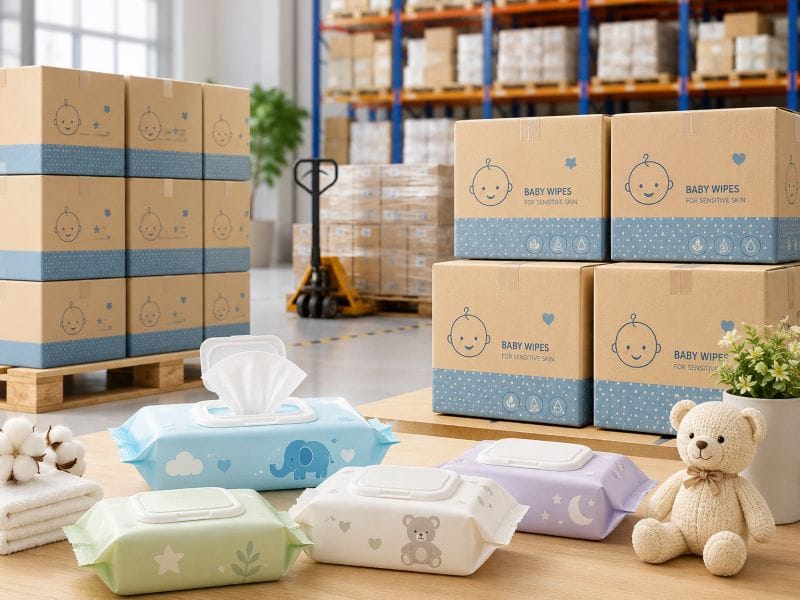
Step 7: Shipping, Logistics, and Delivery
The final step is getting your product from the factory to your warehouse or distribution center.
Shipping Options
| Method | Transit Time | Cost Level | Best For |
|---|---|---|---|
| Sea freight (FCL) | 25-40 days | Low | Large orders, full container loads |
| Sea freight (LCL) | 30-45 days | Medium | Smaller orders, shared container |
| Rail freight | 18-25 days | Medium | Europe-bound shipments from China |
| Air freight | 5-10 days | High | Urgent orders, small quantities, samples |
Export Documentation
Your OEM partner should prepare or assist with:
- Commercial invoice and packing list
- Bill of lading (B/L) or airway bill
- Certificate of origin (if required for preferential tariff treatment)
- Product-specific certificates (CE, FDA, etc.)
- Fumigation certificate (if using wooden pallets)
Cost Breakdown: What to Expect
Understanding the cost structure helps you budget accurately and negotiate effectively. Here is a typical cost breakdown for a private label wet wipes project:
| Cost Component | Typical Range | Notes |
|---|---|---|
| Unit product cost | $0.02 – $0.15 per pack | Depends on wipe count, substrate, formulation, pack size |
| Mold/tooling fees | $500 – $3,000 | Custom packaging shapes or unique dispensing formats |
| Printing plates | $200 – $800 per SKU | For custom printed packaging |
| Sample development | $100 – $500 | Often waived for committed orders |
| Testing and certification | $500 – $3,000 | Microbial, stability, market-specific tests |
| Shipping | Varies widely | Based on volume, destination, and method |
Cost Optimization Tips
• Start with standard packaging formats to avoid mold fees
• Order multiple SKUs in one shipment to optimize container utilization
• Commit to annual volume agreements for better unit pricing
• Consider seasonal planning to avoid peak-season surcharges
Typical Timeline from Concept to Delivery
Weeks 1-2: Product Definition
Define product type, target market, volume requirements, and budget
Weeks 3-6: Manufacturer Selection
Research, evaluate, request quotes, conduct factory audits
Weeks 7-10: Formulation and Sampling
Custom formulation development, 2-3 sample rounds, substrate testing
Weeks 11-13: Packaging Design and Compliance
Packaging artwork, regulatory labeling, compliance review
Weeks 14-16: Testing and Final Approval
Lab testing, stability tests, final pre-production sample approval
Weeks 17-20: Mass Production
Full production run, quality control, batch documentation
Weeks 21-24: Shipping and Delivery
Export documentation, freight transit, customs clearance, final delivery
Final Thoughts
Launching a private label wet wipes brand is a multi-step process, but it is far more manageable when you have a knowledgeable OEM manufacturing partner guiding you through each stage.
The key to success is not just finding a factory — it is building a partnership with a manufacturer who understands your market, supports your growth, and maintains the quality standards your brand depends on.
From product definition to formulation, packaging, compliance, production, and delivery, every step matters. And every step gets easier when you work with a team that has done it thousands of times before.